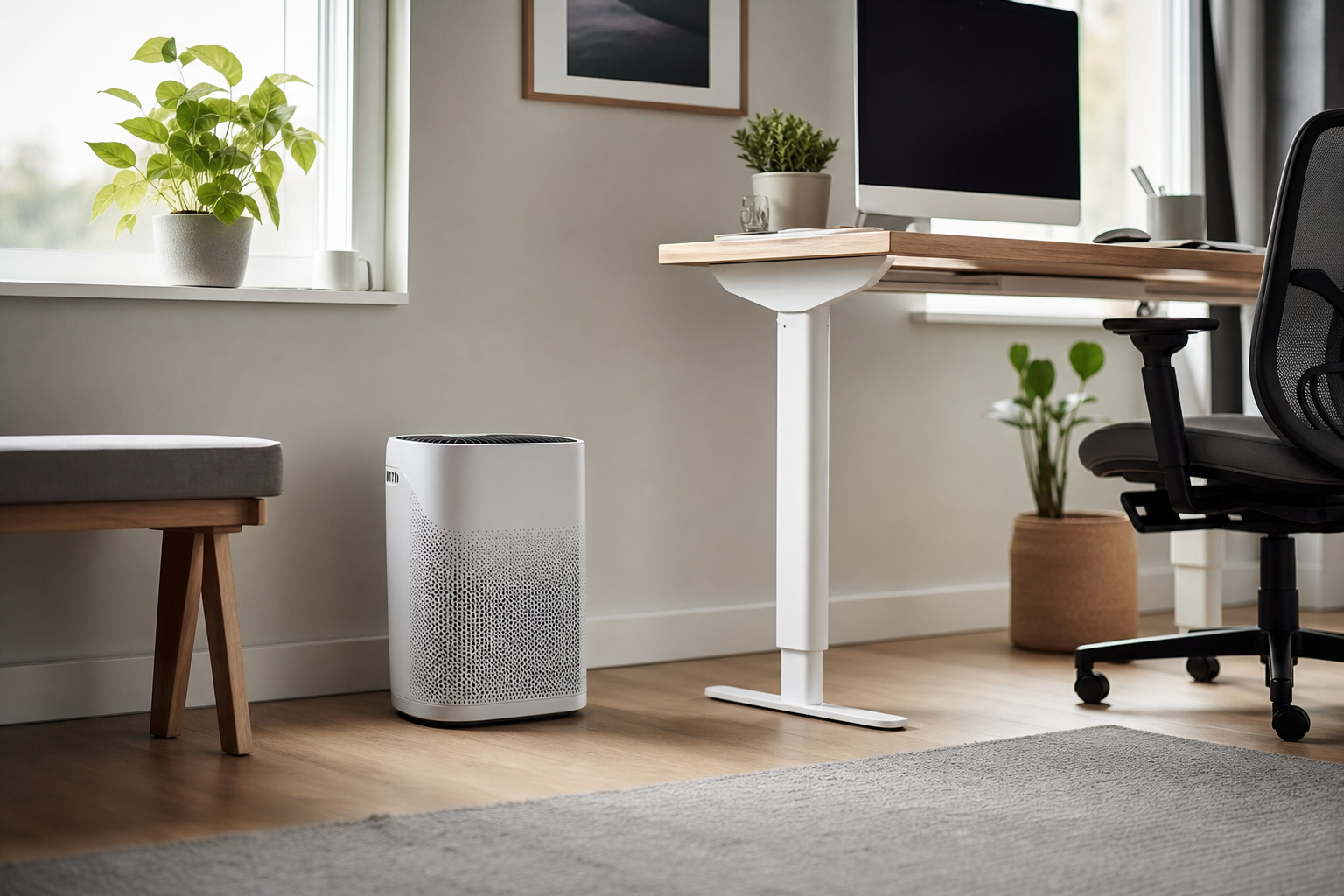
Choosing an office air purifier is mostly about removing friction. The unit should be easy to place, easy to hear over, and easy to maintain. If it becomes a loud object in the corner or a filter subscription nobody understands, it will not stay useful for long.
Filtration
Look for clear HEPA-style filtration language, a sealed housing, and replacement filters that are easy to find.
Noise
A purifier that only works on its loudest mode is rarely right for a focus space. Quiet medium settings matter.
Room fit
Match the purifier to the office size rather than buying only by shape or sale price.
Match the purifier to how the office is used
A private office, shared desk pod, meeting room, and home office all behave differently. A small unit can be ideal beside a single desk, while a meeting room may need better air movement because people come and go in short bursts. Think about where people sit, where doors open, and whether the purifier can breathe freely without becoming a trip hazard.
For a focused work area, it helps to choose a model with several fan speeds. That gives you a quiet daily mode and a stronger refresh mode for lunch breaks, cleaning days, or periods when the room feels stale.
Understand the filter stack before buying
Most useful office purifiers combine a pre-filter with a fine particle filter and, in some cases, carbon. The pre-filter catches larger dust and hair. The main filter handles fine airborne particles. Carbon can help with mild odors, although it should not be treated as a cure for strong chemical smells or poor ventilation.
The practical question is not only what the filter claims to do, but whether replacements are affordable and easy to order. A purifier with expensive, hard-to-find filters often gets neglected after the first change.
Noise matters more than spec sheets suggest
Office sound is personal. Some people like a soft fan sound; others find it distracting. The safest choice is a purifier that can run quietly on a meaningful setting, not just a sleep mode that barely moves air. If the office is used for calls, place the purifier away from microphones and avoid aiming airflow directly at the desk.
Make maintenance simple
Filter reminders are helpful, but a shared office still needs a small routine. Keep a note of the filter size, date changed, and cleaning interval. Vacuum the outside grille gently, keep papers away from the intake, and avoid placing the purifier behind curtains or storage boxes.
In a home office, the same rule applies. If the purifier is tucked where it is hard to reach, it is less likely to be cleaned. Put it somewhere practical and let the simple habits do the work.
Final buying notes
The strongest office choice is usually not the biggest or most expensive unit. It is the purifier that suits the room, stays quiet during work, and has a filter routine you can actually keep. Prioritize fit, noise, and maintenance before extra modes.
For product-level comparisons and buying notes, visit LeStallion’s guide to best indoor air purifiers for office environments.
Previous cloud reference: see the completed OVH office comfort cluster on office area rugs for workspace warmth.